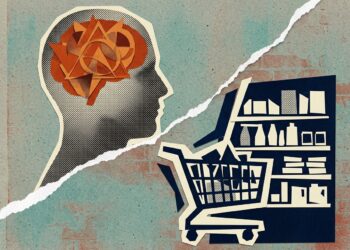
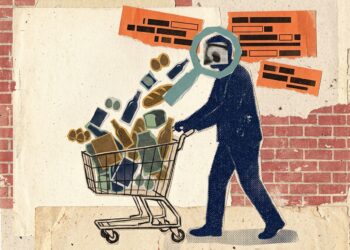
Retailers are increasingly adopting artificial intelligence (AI) to run autonomous stores. In these locations, technologies like computer vision and smart shelves eliminate the need for traditional checkout lines. While businesses benefit from lower operating costs and extended hours, a new study explores how this lack of human interaction affects people after they leave the store.
Research published in the Journal of Marketing indicates that shopping in automated retail environments reduces a person’s willingness to engage in helpful or charitable acts. The researchers found that eliminating human service encounters alters consumer behavior beyond the immediate shopping trip.
Xiaoyan Liu of Southwestern University of Finance and Economics led the investigation alongside Chi Hoang of ESCP Business School and Sharon Ng of Nanyang Technological University. The team observed that existing literature heavily favored the operational aspects of autonomous stores, such as cost savings and shopping speed.
The authors argue that removing retail workers disrupts a fundamental social fabric. They designed a research program to test whether the absence of these everyday human interactions suppresses prosocial behavior, which includes actions like volunteering, donating to charity, and helping strangers.
Testing the Effects of Automation
The research team conducted nine experiments across online and real-world settings. In one field experiment, they set up an observation post outside two adjacent convenience stores of the same brand on a university campus in Singapore. One store was fully autonomous, and the other was staffed by two human employees.

As customers exited, researchers approached them and asked if they would volunteer for a campus buddy program. Customers leaving the AI-driven store committed to significantly fewer volunteer hours than those leaving the human-operated store. The researchers accounted for variables like past shopping habits and demographics, and the behavioral difference remained consistent.
Another experiment tested whether giving the AI a human-like body would change the outcome. The researchers ran a study in a hotel where participants interacted with either a human receptionist or a humanoid robot named Edgar. Edgar featured a male voice and synchronized its gestures with its speech.
After the interaction, the receptionist asked participants to complete either a short five-minute survey or a longer fifteen-minute survey. The longer survey was described as more helpful for the hotel’s service improvement. Participants who interacted with the robot were significantly less likely to choose the longer, more helpful survey compared to those who interacted with the human staff member.
The researchers also tested these effects in online scenarios. In one instance, participants read detailed descriptions of either an autonomous grocery store or a traditional one. Afterward, they were asked to write an encouraging letter to orphans supported by a partner charity. Those who imagined shopping in the AI-driven store wrote significantly shorter letters than those in the traditional store condition.
The Role of Social Connectedness
The researchers trace this behavioral shift to a specific psychological process. In traditional retail settings, small exchanges with cashiers provide subtle touchpoints that remind people they are part of a broader community. Autonomous environments foster a sense of independence and self-sufficiency but reduce these opportunities for social connection.
The study showed that experiencing an AI-driven store was linked to a drop in how connected customers felt to society. This diminished sense of social connectedness, in turn, led directly to a lower likelihood of engaging in prosocial behavior. The researchers found this drop in connection occurred regardless of whether the AI was a hidden background system or a physical humanoid robot.
To verify this sequence of events, the team ran a separate experiment where they manipulated participants’ baseline feelings of connection. Before reading about a robot-operated restaurant, some participants completed a word puzzle designed to remind them of their reliance on others. For these individuals, the negative effect of the automated environment disappeared, and their willingness to volunteer remained high.
Strategies to Preserve Generosity
The research team designed further experiments to test practical strategies that might prevent this decline in generosity without requiring businesses to abandon automated technology. First, they looked at the impact of shopping companions. They found that shopping with a friend or family member preserved the customer’s sense of social connection.
In these joint shopping scenarios, prosocial behavior did not decline after visiting an autonomous store. The researchers interpret this as evidence that the social interaction between companions compensates for the lack of employee contact. The natural collaboration involved in shopping together buffers the isolating effects of the technology.
Retailers can also change how they communicate the purpose of their AI systems. The researchers tested what happens when an autonomous store explicitly frames its technology as a tool for consumer welfare. Promotional materials in this test emphasized that the AI saved customers time, reduced stress, and provided round-the-clock access to healthy food.
When the technology was presented as a benefit to the shopper rather than a cost-cutting measure for the store, customers felt more cared for. This perception maintained their feelings of social connectedness. As a result, the subsequent drop in charitable behavior was prevented.
Finally, the authors suggest that charitable organizations operating near autonomous stores can adapt their own messaging. Charities often frame donations as a way to help the broader community. However, the study revealed that appeals highlighting personal benefits performed better in automated environments.
The researchers presented participants exiting an imagined autonomous store with a charity appeal for a first aid kit project. When the donation poster emphasized how the program would benefit the donor and their immediate family, people donated just as much as those shopping at traditional stores. The self-focused messaging successfully engaged consumers who were already in a heightened state of independence.