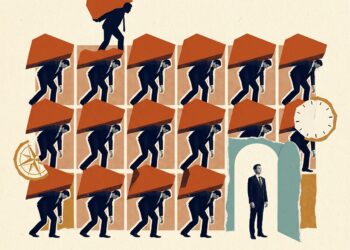
Picture an office where an employee asks a colleague for a client template or a quick walkthrough of a tricky software tool. Instead of helping, the colleague feigns ignorance, offers a vague excuse, or promises to send the file over later with zero intention of following through.
Organizational psychologists call this behavior “knowledge hiding,” and it can quietly stall a company’s ability to learn, innovate, and adapt. A new study published in Frontiers in Psychology investigates how a manager’s leadership style can push workers to guard their expertise rather than share it with their peers.
The research reveals that working under an authoritarian boss is linked to higher rates of knowledge hiding among staff. According to the study, this connection unfolds through a chain reaction involving frustrating workplace obstacles and a heightened fear of job loss.
The Hidden Cost of Strict Control
When companies struggle with internal collaboration, researchers often look at interpersonal friction between coworkers, such as mutual distrust or office rivalries. Bowen Shan and Xiu Jin of Gachon University in South Korea wanted to know how broader management structures and workplace stress shape an employee’s decision to withhold information.
Specifically, the duo focused on authoritarian leadership, a management style defined by centralized power, unilateral decision-making, strict discipline, and an expectation of unquestioned obedience. While previous studies have noted that this rigid approach can force short-term compliance on routine tasks, it also takes a toll on employee well-being and silences open feedback.

Shan and Jin set out to test whether this top-down pressure also encourages active secrecy among coworkers. Unlike simply forgetting to share a helpful tip, knowledge hiding is the deliberate concealment of information when a colleague specifically asks for it.
To get a complete picture of how workers hold back information, the researchers looked at four distinct tactics. Employees might engage in “playing dumb” by pretending they do not know the answer, or “evasive hiding” by providing incorrect details or making false promises to help later.
Workers can also use “rationalized hiding,” which involves offering an excuse or blaming company rules for why they cannot share a file. A fourth tactic is deliberate procrastination, where an employee drags their feet on a request until the information is no longer useful.
Why Stressed Workers Guard Their Expertise
To explain why a commanding boss would trigger these four behaviors, Shan and Jin drew on established psychological theories about how people manage workplace stress and protect their personal standing. These frameworks suggest that when workers feel their core resources, such as their autonomy, energy, or job stability, are under threat, they shift into a defensive mode.
The researchers proposed that authoritarian managers set off this defensive reaction by creating “hindrance stressors” in the daily work environment. Unlike a tough deadline or a complex project that might motivate a team to grow, hindrance stressors are frustrating barriers that block people from getting their jobs done.
Examples of hindrance stressors include bureaucratic red tape, office politics, confusing role expectations, and arbitrary rules. Because authoritarian leaders tend to rely on close surveillance, punitive discipline, and opaque decision-making, the authors argue that these bosses naturally multiply the number of frustrating obstacles their subordinates face every day.
Over time, being bogged down by red tape while answering to an unpredictable, punishing supervisor can make employees question their future at the company. This chronic uncertainty is known as job insecurity.
When workers worry that a single misstep or an arbitrary management decision could cost them their livelihood, helping a colleague becomes a secondary priority. In that state of anxiety, the researchers note, employees may treat their specialized knowledge as private leverage, hoarding what they know to make themselves harder to replace.
Tracing the Chain Reaction in Smaller Firms
Shan and Jin tested their ideas among employees working at small and medium-sized businesses in China. The authors noted that these smaller enterprises offer a fitting testing ground because they frequently feature traditional, top-down hierarchies while simultaneously relying on informal knowledge sharing to survive with limited resources.
The researchers recruited 363 full-time adult employees through company managers and the social media platform WeChat to complete an anonymous online questionnaire. The sample was nearly evenly split between men (47.4 percent) and women (52.6 percent), and 46.3 percent of the respondents had worked at their companies for seven years or more.
Using a seven-point scale ranging from “strongly disagree” to “strongly agree,” participants rated a series of statements about their workplace. They evaluated their supervisor’s behavior on items such as, “We have to follow the leader’s rules to get things done. Otherwise, they punish us severely.”
Respondents also rated how much their job demands thwarted their personal goals, how worried they were about losing their jobs in the near future, and how often they used each of the four knowledge-hiding tactics when colleagues asked for help. Shan and Jin then used statistical models to trace how these factors connected to one another.
The data supported all of the researchers’ hypotheses. Employees who rated their bosses as more authoritarian were significantly more likely to report playing dumb, being evasive, making excuses, and procrastinating when asked for information.
Beyond that direct link, the statistical analysis mapped out a clear step-by-step progression. First, authoritarian leadership was moderately associated with higher levels of hindrance stressors.
Second, those frustrating workplace obstacles were linked to a spike in job insecurity. Finally, that heightened fear of job loss was directly associated with increases in all four forms of knowledge hiding.
The analysis also showed that hindrance stressors and job insecurity each acted as independent bridges between controlling leadership and secretive behavior. Even when employees are not actively worried about getting fired, the sheer mental exhaustion of navigating a boss’s rigid rules and red tape is linked to withholding knowledge, likely as a way for tired workers to conserve their own time and energy.
Managing for Openness and Study Limitations
For business owners and managers, the findings illustrate how demanding strict obedience can backfire behind the scenes. A commanding supervisor might secure surface-level compliance from subordinates, yet those same employees may be quietly undermining team performance by refusing to share vital know-how with their peers.
To keep information flowing, Shan and Jin suggest that organizations invest in leadership training that steers supervisors away from punitive control and toward supportive, two-way communication. Companies can also blunt the chain reaction by auditing their internal processes to remove unnecessary red tape, clarify daily job expectations, and establish transparent criteria for promotions and evaluations so staff feel secure in their roles.
Providing workers with greater autonomy, regular feedback, and team-based rewards for collaboration can also reduce the temptation to treat expertise as a private shield. However, the researchers point out several limitations that temper how broadly their conclusions should be applied.
Because the study relied on self-reported survey data collected at a single point in time, the findings demonstrate statistical relationships rather than definitive cause-and-effect. In addition, the survey did not gather specific details about the participants’ industry sectors, geographic regions within China, or exact company sizes.
As a result, the patterns seen in this group of 363 workers cannot be automatically generalized to every small or medium-sized enterprise across the country. The authors suggest that future studies could track employees over multiple periods, compare worker ratings with supervisor evaluations, and measure how cultural norms around authority and personal workplace networks shape the way staff respond to demanding bosses.