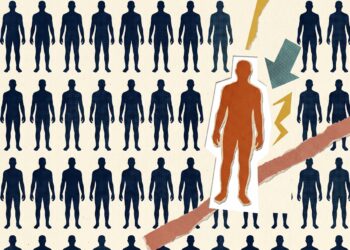
Picture a 63-year-old cashier who would love to hang up her apron but can’t afford to lose her paycheck or her health insurance. She’s hardly alone. In the United States, the share of employed adults over 60 nearly doubled between 2000 and 2020, and while some of those workers are staying on the job because they enjoy it, many are staying because they feel they have no other choice.
A new analysis published in The Gerontologist examines what happens to the health of older Americans who fall into that second group. The finding: workers who report wanting to retire but continuing to work out of financial or insurance-related necessity, a condition researchers call “job lock,” face notably worse mental and self-rated health over the following six years compared to peers who work by choice.
A question about who benefits from working longer
Policy conversations often frame rising labor force participation among older adults as a positive sign. But researchers have increasingly asked whether working longer is genuinely beneficial or whether it reflects constrained choices, especially for lower-wage workers, women, and people of color.
Laura Chen of the Harvard T.H. Chan School of Public Health and Aresha Martinez-Cardoso of the University of Chicago set out to test whether job lock, specifically, predicts poorer health down the line. Earlier work has generally been limited to short time frames or focused narrowly on mental well-being or workplace injuries. Chen and Martinez-Cardoso wanted to look further out in time and across a wider array of physical and mental health outcomes.
Their theoretical starting point draws on decades of research showing that a lack of control over one’s circumstances is a well-established risk factor for poor mental health and cardiovascular problems. Job lock, they reason, embodies exactly that kind of powerlessness: the sense of being stuck in work you’d rather leave, with the door to retirement closed by financial pressures or insurance dependence.
How the study was built
The researchers drew on the Health and Retirement Study, a long-running nationally representative survey of older Americans. They focused on 5,217 workers aged 50 and older who answered a psychosocial questionnaire in 2008 or 2010 and were followed up for six years.
The exposure of interest came from two questions asked of respondents who were currently employed: “Right now, would you like to leave work altogether, but plan to keep working because… you need the money? … you need health insurance?” Answering yes to either question flagged a respondent as experiencing job lock.
The team then tracked a range of health outcomes at each survey wave: self-rated health, depressive symptoms, diagnosed psychiatric problems, body mass index, heart disease, high blood pressure, diabetes, and stroke. They used statistical models that adjust for repeated measurements from the same person and controlled for a long list of potential confounders including age, sex, race and ethnicity, education, marital status, household income, assets, insurance coverage, smoking, drinking, and physical activity.
They also ran models that additionally controlled for baseline levels of each health outcome, which offers a more conservative estimate but may also strip out real effects if job lock had already been affecting a person’s health before the survey began.
Job lock is common, and it’s linked to worse health
The first striking result: 77% of the working respondents reported job lock. In other words, more than three-quarters of these older workers said they’d like to leave work but felt they couldn’t because of money, insurance, or both.
Compared to workers who were not job locked, those who were tended to be younger, more likely to be women, more likely to identify as Hispanic or non-Hispanic Black, and had lower household income and fewer assets. They also reported worse health at baseline and were more likely to still be working at each follow-up wave.
Over the six-year follow-up, baseline job lock was associated with meaningfully higher odds of several adverse outcomes. Job-locked workers had about 47% higher odds of reporting fair or poor self-rated health, 50% higher odds of elevated depressive symptoms, 34% higher odds of a psychiatric diagnosis, and roughly 22 to 29% higher odds of being overweight or obese. These associations held after adjusting for demographics, finances, and health behaviors.
Associations with specific cardiometabolic diseases like high blood pressure, diabetes, and stroke were generally weaker and inconsistent in the full sample.
The picture sharpens for older workers and long-term stayers
When the researchers narrowed the sample to workers aged 62 and older, the age at which Social Security benefits first become available, a new link emerged: job lock was associated with about 25% higher odds of heart disease. Chen and Martinez-Cardoso interpret this as consistent with the idea that continued work is more clearly a departure from social norms after 62, potentially making it a more potent source of stress.
The associations grew stronger still among the roughly 2,500 respondents who remained employed throughout the full six years. In this group, job-locked workers had nearly three times the odds of elevated depressive symptoms and nearly twice the odds of a psychiatric diagnosis or fair-to-poor self-rated health, compared to non-job-locked peers who also kept working. Prolonged exposure to the condition, the authors suggest, appears to compound its harms.
Two flavors of job lock
The researchers also separated out the two reasons for job lock. Both forms were consistently linked to poorer mental health, worse self-rated health, and higher weight. But job lock tied specifically to a need for health insurance had a distinctive pattern: it was uniquely associated with higher odds of heart disease and diabetes, even after adjusting for a wide range of factors.
The authors read this as pointing to a difficult cycle. Workers with existing chronic conditions are more likely to depend on employer-provided insurance, which raises their risk of job lock, and staying in a job they’d rather leave may then further harm their health.
Caveats and what the study can’t say
Chen and Martinez-Cardoso are direct about the limits of what they can conclude. Job lock was measured through simple yes/no questions and only among people who were currently working, so those in more precarious employment situations or those who had already left the workforce due to poor health are underrepresented.
Because the job lock measure wasn’t introduced until 2008/2010, the researchers cannot tell how long respondents had already been experiencing job lock before the study began. Health outcomes were self-reported, and the observational design means the results should be read as associations rather than proof that job lock causes worse health. Reverse causation, where poorer health drives dependence on employer insurance and therefore job lock, is likely part of the picture too.
When the researchers added a control for pre-baseline health to their models, many of the associations weakened. The authors note this may reflect the challenge of separating cause from consequence when the exposure has likely been operating for years before it was measured.
Policy implications the authors highlight
The researchers argue that the findings speak to ongoing debates about raising retirement ages. As Chen and Martinez-Cardoso put it, policies pushing later retirement are unlikely to affect everyone equally, and may deepen existing inequalities for workers who lack the resources to stop working when they’d like to.
They suggest several structural responses: strengthening income supports and social insurance, expanding access to affordable non-employer health coverage, and shifting more of the risk of retirement investing away from individual workers. At the workplace level, they point to phased retirement options, accommodations for workers with chronic conditions, and better wages and protections as potential paths for better aligning older workers’ jobs with their preferences.
The researchers frame job lock not as an individual shortcoming but as the product of a system in which basic economic security is tightly bound to continued labor force participation, sometimes at real cost to health.