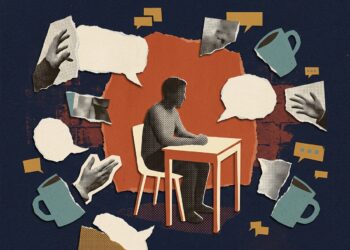
Anyone who has worked a customer-facing job knows the drill: smile at the rude patron, stay chipper during the eight-hour rush, swallow the frustration when someone snaps at you. And anyone who has worked such a job also knows the temptation that often follows the shift: a drink, or two, to take the edge off.
Researchers have long suspected a link between the emotional demands of service work and after-hours alcohol use, but the evidence has been inconsistent. A new investigation published in the Journal of Occupational and Organizational Psychology proposes a different way of thinking about that link, and finds that drinking after a taxing day at work may be less about willpower running dry and more about a deliberate choice to feel like yourself again.
A puzzle in the existing research
For years, the dominant explanation for the connection between emotional labor and drinking has drawn on the idea of “ego depletion,” the theory that self-control is a finite resource that gets used up over the course of a day. Faking a smile for hours, the thinking went, drains the mental reserves a person needs to resist a nightcap. But when researchers actually tested that pathway, results were mixed. Some studies found the expected connection; others did not.
Nai-Wen Chi of National Sun Yat-Sen University in Taiwan and colleagues at Emlyon Business School and Hang Seng University of Hong Kong suspected the depletion story was missing something. Their alternative explanation borrows from a different tradition in the alcohol research: the motivational model, which frames drinking as a strategic choice people make to achieve a specific outcome, such as easing stress or dulling negative feelings.
The authors combined this motivational view with what is called the social interaction model of emotional labor, which treats emotion regulation at work as a fundamentally social act. Their argument, in short: when service workers fake emotions all day, they don’t just get tired. They feel inauthentic. And inauthenticity is unpleasant enough that some people will actively try to shake it off with a drink.
How the studies worked
To test the idea, the researchers ran two experience-sampling studies with full-time customer service workers in Taiwan. Experience sampling means participants complete short surveys multiple times a day over an extended period, which lets researchers track how experiences fluctuate day to day rather than relying on a single retrospective report.
In the first study, 173 employees across industries including finance, technology, retail, and hospitality submitted nearly 1,500 daily surveys over ten working days. Participants filled out a baseline survey covering demographics and their beliefs about alcohol, then completed an after-work survey each afternoon and a next-morning survey reporting how many standard drinks they had consumed the night before. To qualify, participants had to work traditional business hours in a role with regular customer contact and could not abstain from alcohol.
The after-work survey asked about “surface acting” (faking emotions and suppressing real ones during customer interactions), feelings of inauthenticity, feelings of depletion, and the motive to drink as a way of coping. The morning survey asked about the actual number of drinks consumed. One standard drink was defined as 12 ounces of beer, 4 ounces of wine, or 1 ounce of liquor.
The second study, with 52 service workers submitting 451 daily reports, added extra spacing between measurements. Surface acting was measured right after work, feelings of inauthenticity and drinking motives were measured later that evening, and alcohol consumption was reported the next morning. This design reduces the risk that the results reflect people’s tendency to answer related questions in similar ways.
The chain of events
Across both studies, the pattern held up. On days when employees engaged in more surface acting than usual, they reported feeling less authentic that evening. Those feelings of inauthenticity were, in turn, linked to a stronger motive to drink as a way of coping with unpleasant feelings. And that coping motive predicted how many drinks people actually consumed later that night.
Notably, depletion, the “ran out of willpower” explanation, did not predict alcohol consumption in either study. When the researchers ran the numbers with depletion in the model as a competing explanation, the inauthenticity-and-motivation pathway held up while the depletion pathway did not. The researchers interpret this as evidence that drinking after emotionally demanding work looks more like a deliberate strategy than a lapse in self-control.
Who is most likely to drink to cope
The study also examined a personal belief the researchers call “tension reduction expectancies,” which is the extent to which someone thinks alcohol is genuinely effective at easing stress and helping them unwind. People vary in how strongly they hold this belief.
The connection between feeling inauthentic and being motivated to drink was strong for employees who believed alcohol helps them relax. For those who did not hold that belief, feeling inauthentic did not translate into a drinking motive. In other words, inauthenticity seemed to push people toward alcohol only when they already saw drinking as a workable coping tool.
The results also held when the researchers looked at more severe measures of problematic drinking, such as guilt about drinking, blackouts, or being unable to stop once started, rather than just the number of drinks consumed.
What this means for employers
If drinking after work is a deliberate coping strategy rather than a failure of willpower, then policies aimed at limiting temptation, such as restricting access to alcohol or discouraging happy hours, may miss the point. The authors argue that reducing after-work drinking requires addressing both the source of the strain and employees’ beliefs about how to handle it.
On the strain side, they suggest that organizations reconsider strict emotional display rules where they aren’t essential, cultivate a culture of mutual respect between employees and customers, and give employees more room to express authentic emotions. Training programs that teach “deep acting,” where employees try to actually feel the emotions they need to display rather than merely faking them, might also help.
On the beliefs side, the researchers point to recovery activities such as low-effort leisure, creative hobbies, and psychological detachment from work as alternatives that might crowd out alcohol as a go-to unwinding tool. Prior research has shown that workplace programs can shift employees’ beliefs about what helps them recover from stress.
Caveats
Both studies were conducted in Taiwan, and cultural norms around both emotional expression and drinking vary. The authors note that the correlations they observed between surface acting and alcohol use closely resemble those from U.S.-based samples in prior research, but they call for replication in other cultural settings.
The measures also relied on self-reports, including for alcohol consumption. Future work using wearable devices to capture physiological stress markers or breathalyzers for objective drink measurement could sharpen the picture. And while the temporal design of the second study strengthens claims about the direction of the effect, the studies remain observational rather than experimental, so the results are best read as associations rather than proof of causation. The researchers did test for reverse causality, finding that drinking one night did not predict more surface acting or inauthenticity the following day.
The authors also note that similar dynamics could plausibly apply to other coping behaviors beyond alcohol, such as marijuana use, unhealthy eating, or excessive time on social media, though those were not tested here.